
You make a stack of flashcards, flip through them a few times, feel a warm glow of productivity — and a week later most of the words are gone. If that sounds familiar, you're not lazy and your memory isn't broken. Plain flashcards just have built-in weaknesses that work against long-term memory.
Let's be fair: flashcards aren't useless. The problem is how most people use them. Here are the four reasons rote cards fail — and the upgrade that fixes each one.
Reason 1: They test recognition, not recall
Flip a card, see the answer, think "yes, I knew that." That feeling is recognition— and it's a liar. Knowing a word when you see its answer is very different from being able to produce the word when you need it. Recognition gives you false confidence while real recall stays weak.
The upgrade — active recall. Force yourself to retrieve the answer before you flip: say the meaning out loud, write the word, use it in a sentence. The effort of pulling it from memory is exactly what strengthens it.
If it feels easy, you're probably recognizing, not remembering.
Reason 2: Words sit in isolation
A card that says "ubiquitous = everywhere" gives your brain nothing to hold on to. No grammar, no tone, no situation. Real words live in sentences, and your memory is built to store stories and scenes, not bare definitions.
The upgrade — context. Learn each word inside a sentence or a short story. "Smartphones have become ubiquitous — you see them in every hand on every street."Now the word has a picture, a rhythm and a use. That's what sticks.
Reason 3: You review on the wrong schedule
Most people review cards either too often (the easy ones, because they feel good) or all at once the night before a test. Both waste effort. Memory strengthens most when you review a word right at the edge of forgetting it.
The upgrade — spaced repetition. Space your reviews over increasing intervals — a day, then a few days, then a week. Hard words come back sooner; easy words drift further apart. You spend your minutes where they actually matter.
Reason 4: One easy check isn't mastery
Getting a card "right" once doesn't mean you own the word. You might recognize its meaning but be unable to use it in a sentence or spell it correctly. A single pass hides those gaps.
The upgrade — multi-phase testing. Check the same word from several angles before calling it learned: choose the meaning, drop it into a sentence, then spell it from memory. Only a word that survives all three is genuinely yours.
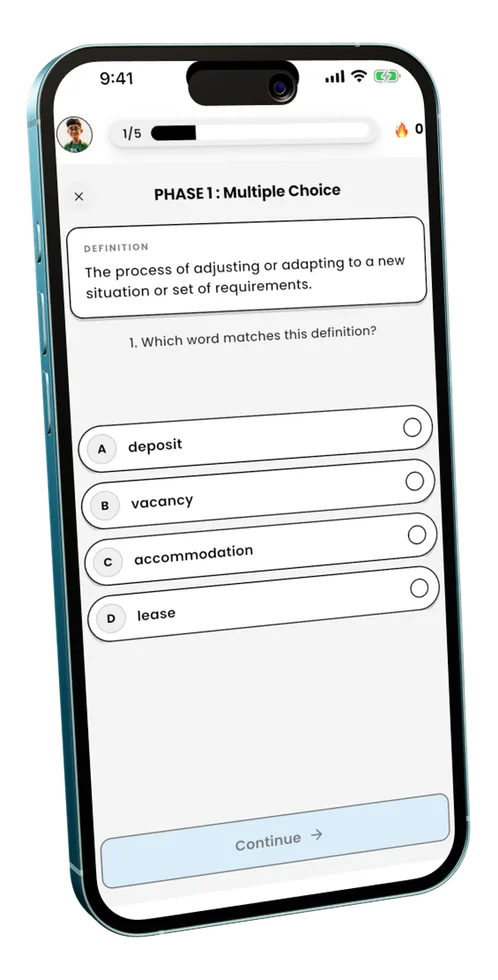
What "what works" looks like
Put the four upgrades together and studying stops feeling like flipping cards into the void:
- Meet the word with its meaning (ideally in your native language).
- See it used in a real sentence or story.
- Recall it actively — produce it, don't just recognize it.
- Review on a spaced schedule, and prove mastery from several angles.
That's not a different amount of work than flashcards — it's the same minutes, spent in a way your brain can actually keep. Keep the cards if you like them. Just stop flipping, and start retrieving.
Put these ideas into practice
VocabMate Pro is built around exactly these principles — native-language meanings in 7 languages, story-based learning, a 3-phase recall test, a 150K-word offline dictionary and daily streaks.