
It's one of the most common questions learners ask: "How many words do I need to know to speak English?" The honest answer is reassuring — far fewer than you think. A native speaker has a vocabulary of perhaps 20,000–35,000 word families, but you don't need anywhere near that to communicate well. What matters is learning the right words, not all of them.
The numbers that actually matter
Decades of language research point to some useful thresholds. They're rough, but they're a great map for setting goals:
- ~250 words — survival English. Greetings, numbers, directions, ordering food. Enough to not get lost on a trip.
- ~800–1,000 words — basic conversation. With the most common 1,000 words you can understand a large share of everyday speech, because a small set of words does most of the work in any language.
- ~3,000 words — the comfort zone. This is roughly the Oxford 3000, and it's the sweet spot: enough to hold real conversations, read simplified texts, and guess a lot from context.
- ~5,000 words — confident, everyday fluency. You can follow most films, conversations and articles without constant lookups.
- ~8,000–9,000 words — the level associated with reading novels and newspapers comfortably and scoring high on exams like IELTS and TOEFL.
The first 3,000 words do most of the work. The next 5,000 are about comfort and nuance.
Why a few thousand words go so far
Language is wildly unequal. A small group of high-frequency words appears constantly, while most words are rare. That's why learning the most common few thousand gives you such a big return: those words cover the majority of what you'll read and hear. Spending your early effort on rare words is like polishing the corners of a house you haven't built yet.
Which words to learn first
Don't pick words at random from a dictionary. Use curated, high-frequency lists that are built for exactly this:
- The Oxford 3000 / 5000 — the most important general English words, chosen by frequency and usefulness.
- Exam word lists — IELTS, TOEFL, GRE and SAT vocabulary target the academic words your test actually rewards.
- Your own life — words from your job, hobbies and the things you read every day. Personal relevance makes them stick.
Counting words isn't the same as knowing them
A word you can recognize on a list isn't really yours until you can useit — understand it in context, recall it from memory, and spell it. That's why "I know 5,000 words" only means something if those words are active, not just familiar. Learn the high-frequency core, practice each word in context and through recall, and a few thousand well-known words will take you further than tens of thousands you've only glanced at.
A realistic goal
If you're starting out, aim for the most common 3,000 words and master them properly. At ten words a day, that's under a year — and it's enough to converse, read and build real confidence. From there, grow by theme and by exam need. You don't need the whole dictionary. You need the right few thousand, learned well.
Put these ideas into practice
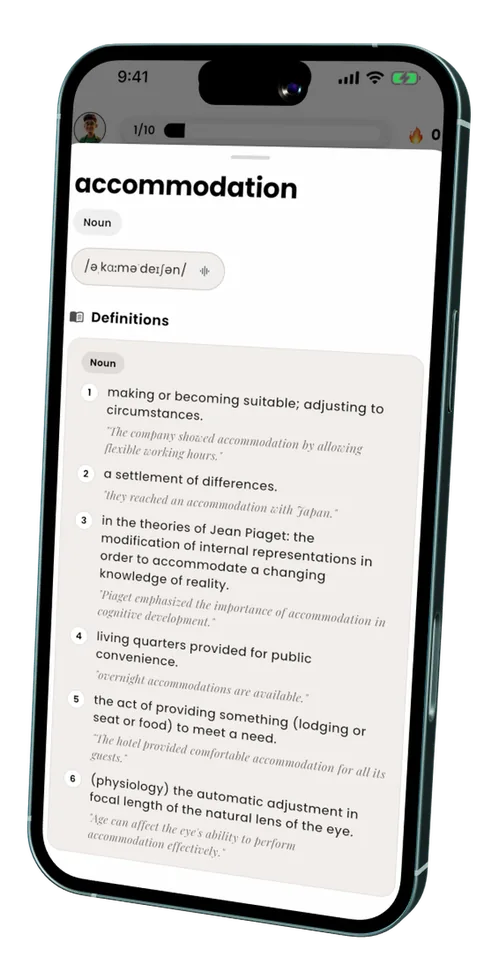
VocabMate Pro is built around exactly these principles — native-language meanings in 7 languages, story-based learning, a 3-phase recall test, a 150K-word offline dictionary and daily streaks.