
Ask someone how they'll improve their English and they'll often describe a heroic plan: two hours a night, a thick word list, a big push before the exam. It almost never lasts. Motivation fades, life gets busy, and the streak breaks. The learners who quietly win do the opposite — a small amount, every single day.
That's not just feel-good advice; it's how memory works. Here's the science, and a simple system you can actually keep.
Why a little every day beats a lot once a week
Memory researchers call it the spacing effect: information reviewed across several days is remembered far better than the same amount studied in one block. Ten minutes a day for a week beats a single 70-minute session — same total time, very different result. Each new day, retrieving yesterday's words just as they start to fade is exactly what locks them in.
Consistency isn't the boring part of learning a language. It's the whole engine.
The habit loop behind a daily routine
Habits form through a simple loop: a cue that triggers the action, a routine you actually perform, and a reward that makes your brain want to repeat it. Most study plans fail because they only have the routine — no reliable trigger, no satisfying reward. Build all three and the habit runs almost by itself.
A simple daily system that works
You don't need a complicated plan. You need a tiny one you'll repeat:
- Keep it small. Aim for about 10 new words a day in a five-minute session. Small enough that you never have an excuse to skip it.
- Attach it to a trigger. Tie practice to something you already do every day — your morning coffee, your commute, brushing your teeth. The existing habit becomes the cue.
- Make it active. Don't just read the words — recall them. Cover the meaning and produce it; use each word in a quick sentence.
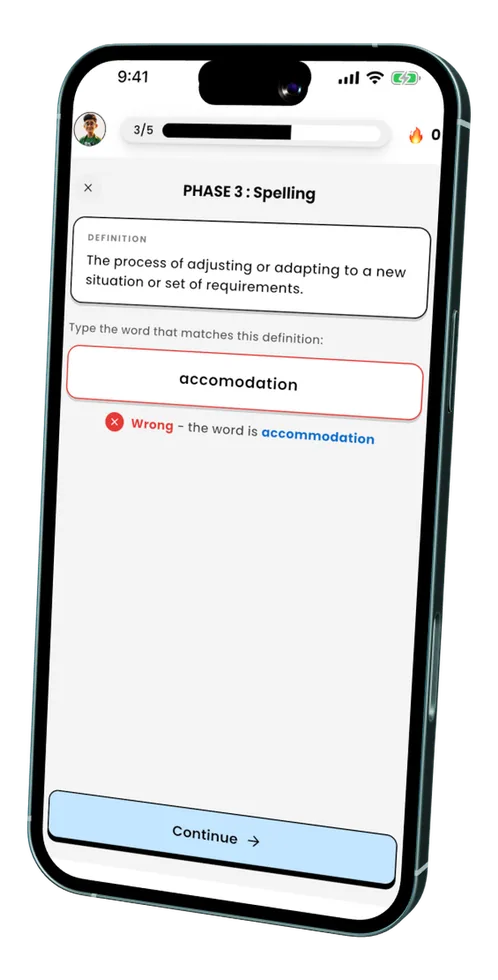
- Reward the streak. Track your run of days and protect it. A visible streak, points or a badge gives your brain the little hit it needs to come back tomorrow.
The three habit killers (and how to beat them)
Almost every broken study habit dies from one of these. Each has a simple fix:
- It's too big. "Learn 50 words a day" collapses by Wednesday. Shrink it until it feels almost too easy, then let momentum grow it.
- There's no trigger. "I'll study when I have time" means you never will. Pin it to a fixed moment in your day.
- There's no reward. If practice feels like pure effort, you'll avoid it. A streak, a point total or a small win at the end gives your brain a reason to return.
Add a weekly review to make it stick
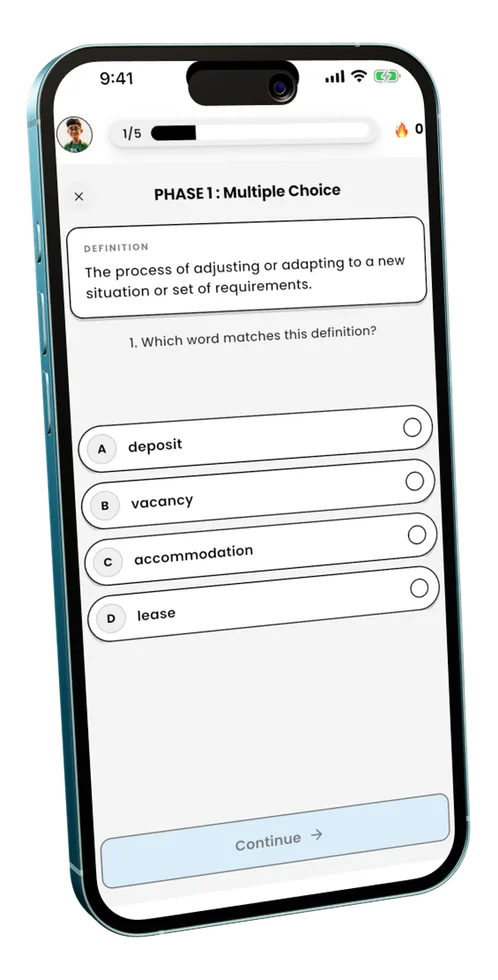
Daily practice plants the words; a weekly review keeps them alive. Once a week, gather the words you learned and test them again — ideally as a bigger challenge that mixes meaning, context and spelling. Revisiting them after a few days' gap is the single best way to move words from "learned this week" into "know for good."
Start today, not Monday
The best day to start a daily habit is the one you're already in. Pick your trigger, learn your first ten words in the next five minutes, and aim only to do it again tomorrow. Keep that going and the maths is on your side: ten words a day is over 3,000 words a year — more than enough to read, write and speak English with real confidence.
Put these ideas into practice
VocabMate Pro is built around exactly these principles — native-language meanings in 7 languages, story-based learning, a 3-phase recall test, a 150K-word offline dictionary and daily streaks.